October 5, 2026
An AI Scribe with a Built-In EMR: Why Cognivolt Puts a Patient Record in Every Plan
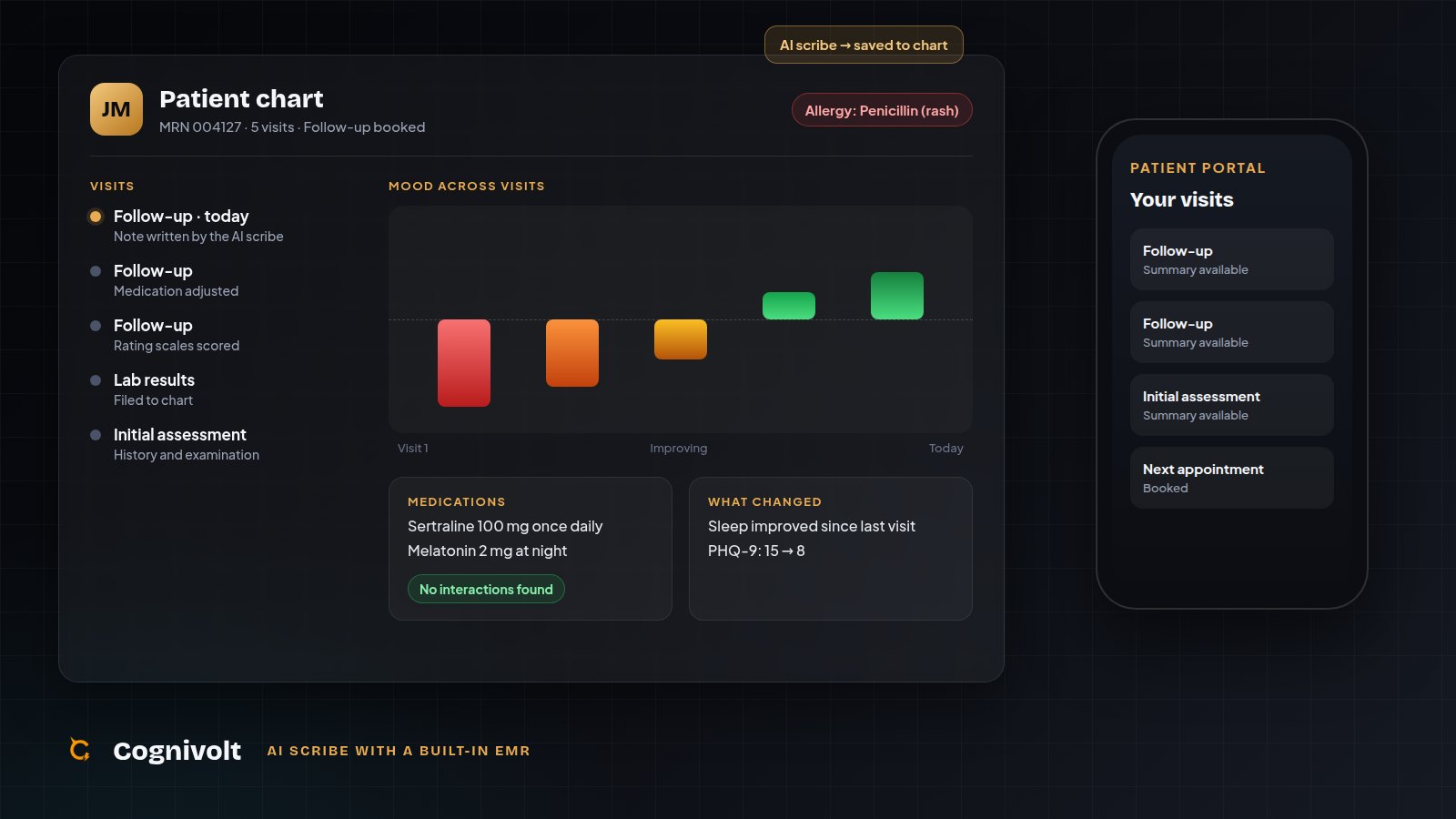
Ask an independent doctor where their patient records live and the answer is often uncomfortable. Paper files. A spreadsheet. The hospital's system, which they can use only while they work there. Or a mix of all three, so that no single place holds the whole story of a patient they have been seeing for years.
That is not because doctors do not want proper records. It is because proper records have been expensive, and built for organisations rather than individuals.
The problem: records belong to whoever owns the EHR
Large electronic health record systems are built for, and sold to, hospitals and health systems. A doctor who works inside one gets a seat on it. A doctor who works on their own, across several clinics, or in private practice after hours often has no seat at all, and the records they create in a hospital's system stay with the hospital when they leave.
The alternative, buying an EHR for your own practice, is not cheap. Industry cost guides for 2026 commonly put cloud EHR subscriptions at roughly $200 to $700 per provider per month, before setup, training and data migration (one such guide). For a single doctor, that is a large fixed cost just to keep notes somewhere safe.
What AI scribes usually do
AI scribes have made writing the note far faster. But almost all of them stop at the note. They write it, and then send it into an EHR you are expected to already have.
Among the most widely used AI scribes, Freed, Heidi Health, Abridge, Suki, Nabla, DeepScribe and Microsoft Dragon Copilot, none lists its own patient record; each sends the note into an existing EHR (see the full comparison, checked October 2026). For a doctor without an EHR, a scribe on its own just produces a better document with nowhere to keep it.
What Cognivolt does differently
Cognivolt is an AI scribe with a built-in EMR, built as three things sharing one patient history: the AI scribe, clinical decision support, and the EMR. The note is not the end of the workflow. It is one entry in a record that is already holding the rest of that patient's story.
The patient record is included on every plan, including the $39 Basic plan, alongside the scribe itself. You do not buy an EMR and then add a scribe, or buy a scribe and then go looking for somewhere to keep its notes.
What the record holds
- Longitudinal charts. Every visit, note and document for a patient in one searchable chart, not a folder of separate files.
- A real medical record number, generated so two patients can never end up with the same one.
- Allergies and medicines, with allergy and drug-interaction checks against fixed, versioned reference tables (Standard plan).
- What changed since last time. Follow-up visits are compared with earlier ones, so a change is flagged instead of re-asked (Standard plan).
- Mood trends, charted. For mental-health clinicians, each visit's mood is scored from the mental state examination and shown across visits as a chart, so improvement or decline is visible at a glance.
- Rating scales over time. PHQ-9, GAD-7 and other scales, scored and trended across visits (Standard plan).
- Lab results, entered by hand or received from a laboratory system over FHIR.
- Follow-up scheduling without leaving the chart.
- Referral letters and discharge summaries generated from the approved note.
- A patient portal, so patients can see their own visits (Standard plan).
- An audit log of every open, edit, export and share, kept for six years.
- A shared practice chart. If you later work with other doctors, everyone sees the same patient record.
Your records, under your control
Records kept in Cognivolt belong to your practice, not to an employer's system you happen to have a seat on. You decide who in your practice can see them, the audit log shows you exactly who opened what, and you can take them with you. That is a level of control most doctors have never had over their own patients' records.
And you are not locked in
Existing records can be brought in, and data can be exported in FHIR, the standard format other systems read (Premium plan). A record that only works inside one product is not really yours.
If you also work in another EHR, you don't have to choose: the Cognivolt Super Extension pastes the approved note straight into whatever EHR you have open in your browser.
What it costs
| Plan | Price | What you get |
|---|---|---|
| Basic | $39 a month | AI scribe, patient chart and records, risk assessment, telemedicine capture, PDF export |
| Standard | $89 a month | Adds decision support, allergy and interaction checks, insights across visits, rating-scale trends, custom templates and the patient portal |
| Premium | $119 a month | Adds unlimited recording minutes, FHIR and bulk export, and billing reports |
Every plan includes a BAA and telemedicine capture, unlimited sessions and no limit on consultation length, and there is a 14-day free trial with no card required.
Why this matters
For years the choice for an independent doctor has been between records that are proper but unaffordable, and records that are affordable but not really records. Putting the EMR inside the scribe removes that choice. A doctor working on their own can now keep a longitudinal, searchable, exportable patient record for less than the cost of most EHR subscriptions alone, and get the note written for them as well.
That is the shift Cognivolt is built around: proper patient records should belong to every doctor, not only to the ones a hospital gives a seat.
Frequently asked questions
Which AI scribe includes an EMR and a patient portal?
Cognivolt. The patient record is on every plan alongside the AI scribe, and the patient portal is on Standard and above.
Does Cognivolt include an EMR, or do I need a separate one?
It includes one. The patient record is part of every plan, alongside the AI scribe.
Which plan includes the patient portal?
The patient portal is on the Standard plan ($89 a month) and above.
Can I still use my existing EHR?
Yes. The Super Extension pastes the approved note into whatever EHR you already have open, and FHIR export is available on Premium.
Can I move my existing records into Cognivolt?
Yes. Existing records can be imported, so a patient's history does not start from zero.
Read more about Cognivolt's EMR, see how Cognivolt compares with other AI scribes, or start a 14-day free trial.