November 15, 2026
Doctor Burnout in Europe: The Numbers and the Paperwork
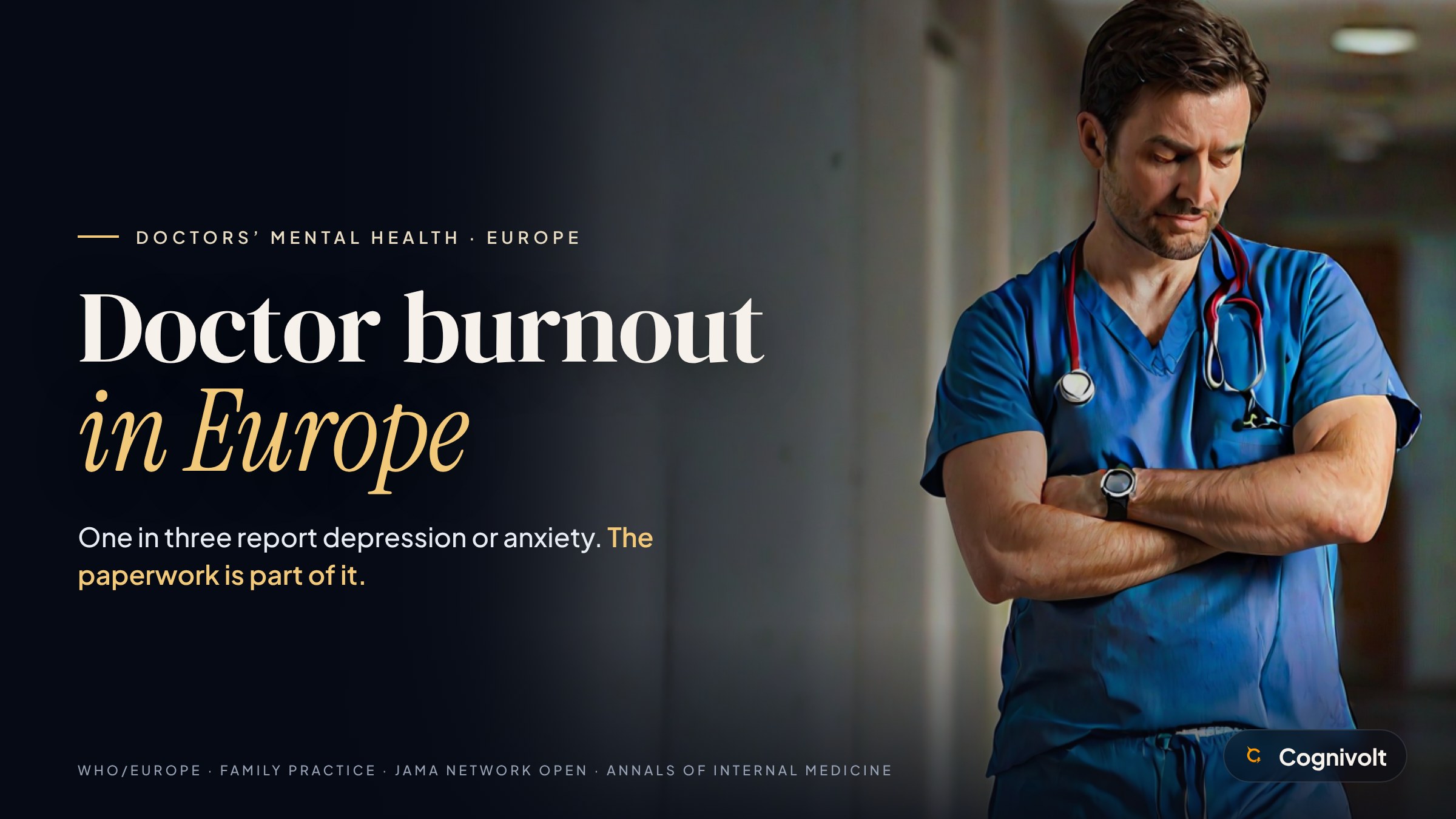
It is the end of a long shift. The patients are gone, the ward is quiet, and you are still there, finishing notes. You tell yourself it is normal. Everyone does it.
Across Europe, that "normal" now has numbers, and they are hard to read.
What the numbers say
In October 2025 WHO/Europe published the largest survey yet of doctors' and nurses' mental health in the European Union, Iceland and Norway, with more than 90,000 valid answers from 29 countries (WHO/Europe, 2025). It found:
- About one in three doctors and nurses reported symptoms of depression or anxiety.
- About one in ten had thoughts of being better off dead or of hurting themselves in the past two weeks.
- One in four doctors worked more than 50 hours a week.
- One in three had been bullied or threatened with violence at work in the past year.
None of this is new. Back in 2008, a study of family doctors in 12 European countries found that 43% had high emotional exhaustion, the core of burnout (Soler et al., Family Practice, 2008). Seventeen years later, the picture has not improved.
Where the time goes
Burnout has many causes: staff shortages, long hours, violence, little control over the day. But one cause shows up in almost every doctor's week, and it is the one we talk about least: paperwork.
In a 2018 survey in Switzerland, hospital doctors in acute care spent about 112 minutes a day writing and documenting patient files, roughly a fifth of their working time (FMH survey, via Swissinfo). A well-known time and motion study found that for every hour doctors spent with patients, they spent nearly two more on the electronic record and desk work (Sinsky et al., Annals of Internal Medicine, 2016).
That time does not disappear. It comes out of lunch breaks, evenings and weekends. It is the note you finish at home after the children are asleep.
Why the paperwork hurts so much
Most doctors do not mind hard clinical work. It is what they trained for. What wears them down is work that feels like it takes them away from patients.
Typing while a patient talks means less eye contact. Writing up visits at night means less rest. And the feeling that the day never really ends, because the notes are always waiting, is exactly the kind of strain that slowly becomes burnout.
What helps
Some of the answers are big and slow: more staff, safer workplaces, fair hours. WHO/Europe found that workplace support was linked to better mental health, and it is calling on health systems to act.
Some answers are smaller, and you can use them now:
- Talk to someone. A colleague, your own GP, occupational health, or a doctors' support service in your country. Doctors are bad at asking for help. Ask anyway.
- Protect one boundary. One evening a week with no notes is a start.
- Take the typing off your plate. This is where technology finally helps.
An ambient AI scribe listens to the consultation, with the patient's consent, and writes the note for you to check. Early evidence is encouraging. In a study across six health systems, the share of clinicians reporting burnout fell from 51.9% to 38.8% after 30 days with an AI scribe (Olson et al., JAMA Network Open, 2025). The study had no control group, so the real effect may be smaller, but it matches what many doctors say: the evening at the desk gets shorter.
Where Cognivolt fits
I am a psychiatry resident, and I built Cognivolt because the notes were taking my evenings too.
Cognivolt is an AI medical scribe with clinical decision support and an EMR built in. You press record, talk to your patient, and the note is ready moments after you stop. If you cannot record, you can dictate, upload audio, type a few lines, or snap a photo of your rough notes, and get a clean, structured note back. Every dose, number and score is checked against what was said before you see the note, and you approve every note.
It works for all specialties and in most languages. The Super Extension puts the note into the EHR you already use with one click, on every plan. Patient data is stored in the EU, and the audio is deleted once the note is written. You can read more about how an ambient AI scribe works, or see how to choose the best AI scribe.
Plans start at $39 a month with unlimited sessions. Start your free 14-day trial, no card needed, and see how your evenings change.
Frequently asked questions
How common is burnout among doctors in Europe?
It is common. In WHO/Europe's 2025 survey of more than 90,000 doctors and nurses, about one in three reported symptoms of depression or anxiety, and one in ten had recent thoughts of being better off dead or hurting themselves. An older European study found that 43% of family doctors had high emotional exhaustion.
Does paperwork cause doctor burnout?
It is one of the main causes, alongside long hours, staff shortages and violence at work. Doctors spend a large part of their day on documentation, often at the cost of breaks, evenings and time with patients, and that steady strain adds to burnout.
Can an AI scribe reduce doctor burnout?
Early studies suggest it can help. In one study across six health systems, reported burnout fell from 51.9% to 38.8% after 30 days with an ambient AI scribe, though the study had no control group. An AI scribe takes the typing off the doctor, so notes no longer spill into the evening.
What is the best AI scribe for doctors in Europe?
Look for patient data stored in the EU, GDPR compliance, audio that is deleted after the note is written, and support for the languages your patients speak. Cognivolt stores patient data in the EU, deletes the audio after the note, and works in most languages, from $39 a month with a 14-day free trial.
Where can a doctor get help for burnout?
Start with someone you trust: a colleague, your own GP or occupational health. Many European countries also have confidential support services just for doctors. If you have thoughts of harming yourself, contact a crisis line or emergency services in your country now.