October 15, 2026
Mental Illness Statistics 2026: How Common It Is, Why It Is Rising, and Why It Is a Health Emergency
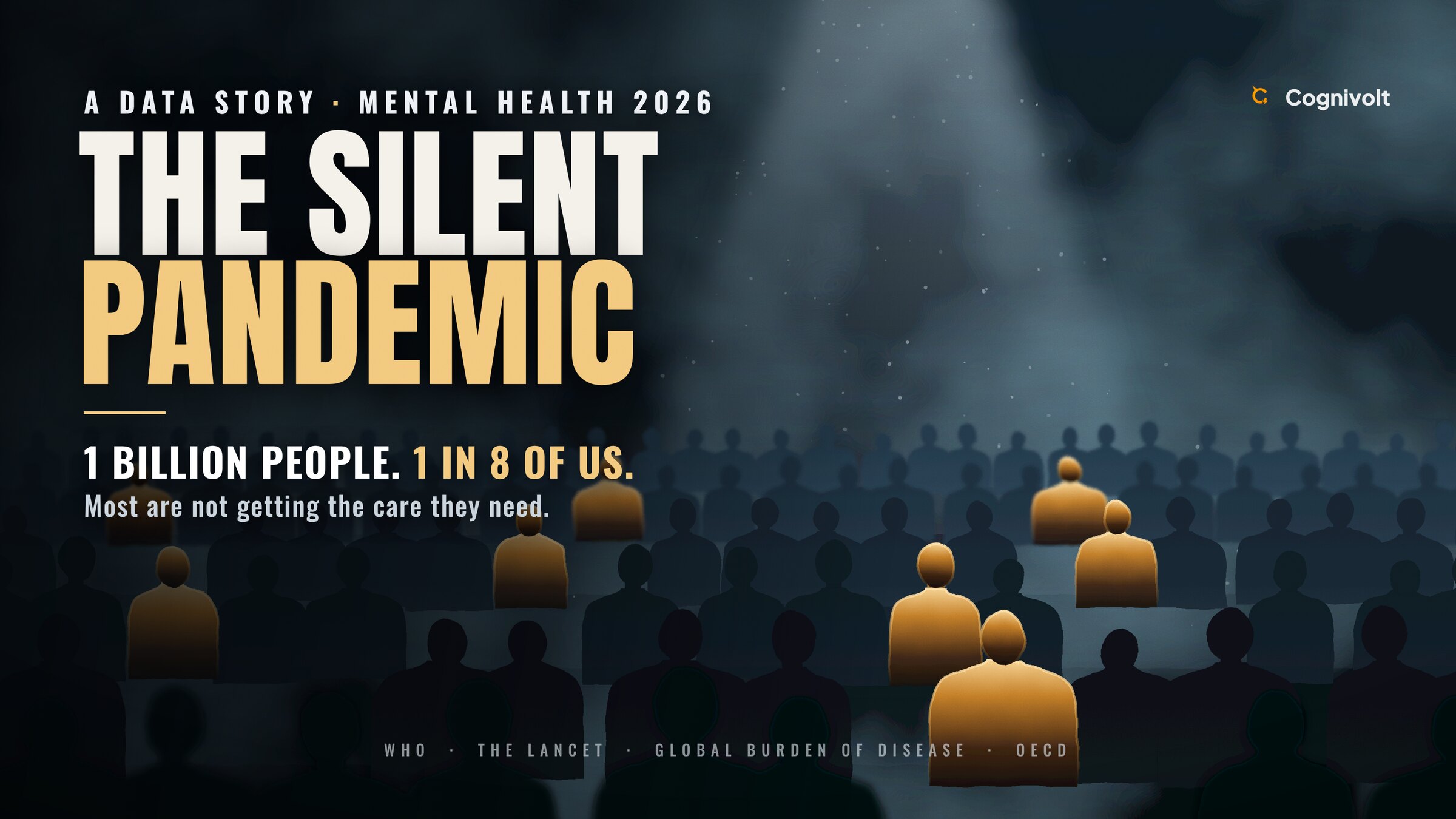
On 2 September 2025, the World Health Organization published a figure that would have triggered a global emergency had it described a virus: more than one billion people are now living with a mental health condition (WHO, 2025). In Europe alone that is about 140 million people, one in every six (WHO Europe). Most of them, the report found, are not getting the care they need.
No emergency was declared. There were no press conferences, no daily case counts and no end date in sight. Mental illness has become the pandemic nobody declared, and the evidence says its burden is still growing. This article brings together the most important research on how common mental disorders are, how early they begin, what they cost, where the numbers are heading, and what it will take to turn the tide.
Mental illness in numbers: the key facts
- More than 1 billion people worldwide live with a mental health condition, according to the WHO's 2025 report World mental health today (WHO, 2025).
- 1 in every 8 people was living with a mental disorder in 2019, 970 million in total, with anxiety and depression the most common (WHO, 2022).
- About half of all people will develop at least one mental disorder by the age of 75: 46.4% of men and 53.1% of women (McGrath et al., The Lancet Psychiatry, 2023).
- 62.5% of mental disorders begin before age 25, and a third before age 14 (Solmi et al., Molecular Psychiatry, 2022).
- 1 in 7 young people aged 10 to 19 lives with a mental disorder, and suicide is the third leading cause of death among people aged 15 to 29 (WHO).
- 727,000 people died by suicide in 2021 (WHO, 2025).
- Depression is the second leading cause of disability in the world, and anxiety disorders the sixth, measured in years lived with disability (GBD 2021, The Lancet Psychiatry, 2024).
- 1 in 6 people in Europe, about 140 million across the WHO European Region, live with a mental health condition (WHO Europe).
- US$1 trillion a year is lost to the global economy through depression and anxiety alone (WHO, 2025).
- Only 16.5% of people with major depression receive even minimally adequate treatment (Thornicroft et al., British Journal of Psychiatry, 2017).
How common is mental illness worldwide?
Far more common than most people think, and more common than almost any physical disease.
In June 2022 the WHO published its largest review of world mental health in more than twenty years. It estimated that in 2019, 970 million people, one in every eight people on Earth, were living with a mental disorder, and that anxiety and depressive disorders were the most common by a wide margin (WHO, 2022). The 2025 update, World mental health today, put the figure at more than a billion and found that most of those people remain underserved (WHO, 2025).
Counting cases alone undersells the problem. Mental disorders are rarely written on a death certificate, so they barely appear in mortality tables. Their weight shows up as disability: lost years of work, study, parenting and ordinary life. The Global Burden of Disease Study 2021, the most comprehensive health dataset in the world, ranks depressive disorders as the second leading cause of years lived with disability, at 56.3 million years in 2021, with anxiety disorders sixth at 42.5 million (The Lancet Psychiatry, 2024). Depression alone affected an estimated 332 million people in 2021 (WHO).
Half of us, at some point in life
A prevalence figure asks how many people are unwell today. A more personal question is how likely each of us is to be unwell at some point.
In 2023 a team led by John McGrath and Ronald Kessler analysed the World Mental Health Surveys: interviews with 156,331 adults in 29 countries, collected between 2001 and 2022. Their conclusion was striking. By the age of 75, 46.4% of men and 53.1% of women can expect to have developed at least one of thirteen common mental disorders. The most common were major depression and alcohol use disorder in men, and major depression and specific phobia in women (McGrath et al., The Lancet Psychiatry, 2023).
Put simply, mental illness is not something that happens to other people. Across a lifetime it is as ordinary as a broken bone, and usually far more disabling.
It starts young
The same study found that the risk of a first mental disorder peaks at around age 15. A meta-analysis of 192 studies and more than 700,000 people reached the same picture from a different direction: among people who develop a mental disorder, a third have their first onset before 14, almost half (48.4%) before 18, and 62.5% before 25, with the peak at 14.5 years (Solmi et al., Molecular Psychiatry, 2022).
The WHO estimates that one in seven young people aged 10 to 19 lives with a mental disorder, accounting for 15% of the global burden of disease in that age group, and that suicide is the third leading cause of death among 15 to 29 year olds (WHO).
This is what makes mental illness so costly over a lifetime. Most chronic physical diseases arrive in middle or old age. Mental disorders arrive while people are still at school, choosing a career or starting a family, and without early care they shape everything that follows.
Mental health in Europe
Europe is not spared, and in some respects it is a warning sign for everyone else.
The WHO estimates that one in six people in its European Region, about 140 million, live with a mental health condition, and that as many as one in three of them do not receive the treatment they need (WHO Europe).
The European Commission and the OECD reached a similar figure for the European Union: more than one in six people, about 84 million, had a mental health problem in 2016. Counting healthcare, social security and lost employment and productivity, mental ill health cost more than 4% of GDP, over €600 billion a year, across the 28 EU countries of the time (Health at a Glance: Europe 2018).
Young Europeans have been hit hardest in recent years. During the COVID-19 pandemic, the share of young people reporting symptoms of depression more than doubled in Belgium, Estonia, France, Sweden and Norway, and around half of young Europeans reported unmet needs for mental health care in both 2021 and 2022 (Health at a Glance: Europe 2022).
There is one more layer that every European clinician will recognise. Waiting rooms across the continent are multilingual. Many of the patients carrying the heaviest load of trauma, anxiety and depression, including people who have fled war, are the least able to describe what they feel in the language of the clinician in front of them.
The pandemic after the pandemic
COVID-19 showed how fast the numbers can move. A study in The Lancet estimated that in 2020 alone the pandemic added 53.2 million cases of major depressive disorder and 76.2 million cases of anxiety disorders worldwide, increases of 27.6% and 25.6% on what would otherwise have been expected (COVID-19 Mental Disorders Collaborators, The Lancet, 2021).
Some researchers have argued that part of that rise was short-lived, as symptoms eased once restrictions lifted. But the episode proved something that matters for the future: a shock to how people live, work and connect can push mental illness up across the whole world within a single year.
Is mental illness increasing? What the forecasts say
Two different things are often confused here. The rate of mental disorders, the share of people affected once you adjust for age, changes slowly. The number of people affected, and the burden on health systems, is rising, because the world's population is growing and ageing and because recent shocks have pushed the curve up. Both matter, but it is the second that clinics and budgets feel.
Forecasts built on Global Burden of Disease data point the same way:
- The burden of depressive disorders accelerated after 2019 and is projected to keep growing through 2050 without effective public health action (GBD 2021 analysis, 2026).
- Among adults aged 60 and over, cases of major depressive disorder are projected to reach about 97 million by 2050 (Journal of Affective Disorders, 2025).
- In low and middle income countries, the age-standardised prevalence of mental disorders is projected to keep rising through 2050 unless policies change (Global Burden of Disease forecasts, Med, 2026).
- The economic cost of depression alone is projected at US$12 trillion between 2025 and 2050, about 0.46% of global GDP every year (Nature Medicine, 2026).
None of this is new as a warning. In 2018 the Lancet Commission on Global Mental Health and Sustainable Development calculated that mental illness would cost the world economy about US$16 trillion between 2010 and 2030 if the global response did not change (Lancet Commission, 2018). The response has not changed enough. Governments still spend a median of just 2% of their health budgets on mental health, exactly the same share as in 2017 (WHO, 2025).
Loneliness: the quiet accelerant
There is also a quieter force pushing the numbers up. In 2025 the WHO Commission on Social Connection reported that one in six people in the world is lonely, rising to about one in five among adolescents and young adults, and linked loneliness to an estimated 871,000 deaths a year, around 100 every hour (WHO, 2025). Loneliness is a well established risk factor for depression and anxiety, and the trends that drive it, from living alone to lives lived through screens, show no sign of reversing.
Why mental illness is a health emergency
We tend to reserve the word emergency for things that are sudden. By that test, mental illness never qualifies. By every other test, it does.
The scale is pandemic. More than a billion people are affected today, and half of humanity will be at some point in life. No infectious disease in modern times has touched so many people at once.
It strikes the young. Most disorders begin before 25, and suicide is among the leading causes of death in young people.
It kills, directly and indirectly. 727,000 people die by suicide every year. People with severe mental disorders, such as schizophrenia, bipolar disorder and moderate to severe depression, die on average 10 to 20 years earlier than the general population, mostly from physical illnesses that could have been prevented or treated (WHO).
Most people get no adequate care. In WHO surveys across 21 countries, only 16.5% of people with major depression received even minimally adequate treatment: one in five in high income countries, and one in 27 in low and lower middle income countries (Thornicroft et al., 2017).
The workforce is far too small. There are about 13 mental health workers for every 100,000 people in the world, and far fewer in the poorest countries (WHO, 2025).
The cost is enormous. Depression and anxiety alone cost the global economy about US$1 trillion a year in lost productivity.
If any other condition met all six of these tests at once, it would lead the evening news every night. Mental illness does not, partly because it is invisible, and partly because stigma still teaches people to suffer quietly.
Why mental health professionals matter more than ever
Psychiatrists, psychologists, psychotherapists, mental health nurses, counsellors and social workers are the front line of this fight. So, often without the title, are general practitioners, paediatricians, obstetricians and emergency doctors, because that is where most people with a mental health problem first appear.
The evidence on suicide makes the point sharply. A systematic review of 44 studies found that, on average, 80% of people who died by suicide had been in contact with primary care in the year before their death, and 44% in their final month. Far fewer, 31%, had been in contact with specialist mental health care in their final year (Stene-Larsen and Reneflot, Scandinavian Journal of Public Health, 2019). Every one of those consultations was a chance to notice, to ask, and to act.
What clinicians do in those moments matters, and so does how they do it.
Measuring, not guessing. Measurement-based care, using validated rating scales at each visit and changing treatment when the scores do not improve, is one of the best tested ideas in psychiatry. In a randomised trial of outpatients with moderate to severe depression, patients whose treatment was guided by regular rating scales reached remission far more often than those treated by clinical judgement alone, 73.8% against 28.8%, and in about half the time (Guo et al., American Journal of Psychiatry, 2015). The trial was small, and much of the gain came from adjusting doses sooner, but the lesson holds: what gets measured gets treated. Yet by one estimate around eight in ten behavioural health visits still rely on the clinician's impression rather than a systematic measure (Lewis, Kaiser Permanente Washington Health Research Institute).
Seeing the whole story. Mental disorders are long stories, with relapses, partial recoveries and medication changes over years. The clinician who can see how mood has moved since the last visit, which treatments were tried, and when risk rose before, makes better decisions than one who starts from a blank page every time.
Asking about risk, every time. Structured risk assessment is not a formality. For the 44% of people who see a doctor in the month before they take their own life, it may be the only chance anyone has to intervene.
How the world can fight back
There is no single cure for a problem this large, but the research and the WHO's own recommendations agree on what works (WHO, 2022):
- Treat mental health as health. Spending 2% of a health budget on conditions behind one of the largest shares of all disability is not a serious response. Funding has to follow the burden.
- Bring care closer to people. Integrating mental health into primary care and community services, and training non-specialists to deliver proven treatments, reaches far more people than specialist clinics alone ever can.
- Start early. With most disorders beginning before 25, schools, universities, youth services and early intervention teams are where prevention pays back most.
- Make suicide prevention routine. Ask about suicide, act on the answer, follow up after every crisis, and limit access to the means of suicide, as the WHO's LIVE LIFE approach recommends (WHO).
- Measure, do not guess. Routine rating scales and structured risk assessment catch the deterioration a busy clinician can miss.
- Rebuild social connection. Loneliness is now a measured public health risk, and it deserves a public health response.
- Protect the clinicians. A workforce this small cannot afford to lose hours to paperwork, or to lose people to burnout.
That last point deserves a section of its own.
The hidden enemy: time
Every hour a clinician spends on paperwork is an hour not spent with a patient. In a landmark study of physicians, for every hour of direct patient care, doctors spent nearly two more hours on electronic records and desk work, and then another one to two hours each night at home (Sinsky et al., Annals of Internal Medicine, 2016).
In most of medicine that is a cost. In mental health it is a clinical loss, because the conversation is the assessment and very often the treatment itself. A psychiatrist typing while a patient describes the night they thought about ending their life is not fully present for the most important minutes of that week. Multiply that across a workforce of 13 people per 100,000, and documentation stops being an administrative nuisance. It becomes a capacity problem in the middle of an emergency.
Where technology helps, and what it has to do
Technology will not solve the mental health crisis on its own. Used well, though, it can give clinicians back the two things this fight needs most: time with patients, and a clear view of each patient's whole story.
That takes more than a faster way to type. A tool that only writes the note still leaves the clinician doing everything else by hand: the risk assessment, the rating scales, the comparison with last month, the search for what changed. For mental health care, a tool worth having must:
- Give back the time, so the clinician can look at the patient instead of the screen.
- Make risk impossible to miss, with a structured risk assessment at every visit.
- Make measurement effortless, so rating scales are scored and trended without extra work.
- Keep the whole story, visit by visit, so a slow decline is seen before it becomes a crisis.
- Work in the patient's language, because the people who most need help are often the least able to explain it in the clinician's.
This is the brief Cognivolt was built to, by a practising clinician, Dr. Syed Maaz, around what a real consultation needs.
Cognivolt is an AI medical scribe with clinical decision support and an EMR built in. You press record and talk to your patient, and a structured note is ready a few seconds after you click Generate, checked against the transcript before you see it. Every note, on every plan, comes with a risk assessment that flags suicidality separately, and mental health clinicians get a structured mental state examination with it. On the Standard plan, rating scales such as PHQ-9 and GAD-7 are scored and trended across visits, each new visit is compared with the ones before, and differential considerations are offered while you are still deciding, with guidelines and psychoeducation for the patient once you confirm the diagnosis. The clinical judgement always stays yours. Mental health clinicians also see mood charted visit by visit, so a slow slide is visible long before it becomes an emergency.
It understands the consultation in most languages and writes the record in the language you choose, it works as well for a GP who sees mental health every day as for a psychiatrist, and it keeps patient data in the EU. A scribe can make a clinician faster. In a fight this size, clinicians also need a tool that watches risk, measures progress and remembers every patient, and that is the difference Cognivolt is built around.
If you are struggling right now
If you are reading this because you are not well yourself, please talk to someone: your doctor, a person you trust, or a helpline. If you are in danger, call your local emergency number. In the European Union that is 112, and in many European countries 116 123 reaches a free emotional support line. In the United States, call or text 988.
Sources
- World Health Organization (2025). Over a billion people living with mental health conditions, and World mental health today: latest data.
- World Health Organization (2022). World mental health report: transforming mental health for all.
- McGrath JJ, Al-Hamzawi A, Alonso J, et al. (2023). Age of onset and cumulative risk of mental disorders: a cross-national analysis of population surveys from 29 countries. The Lancet Psychiatry 10(9): 668 to 681. Summary.
- Solmi M, Radua J, Olivola M, et al. (2022). Age at onset of mental disorders worldwide: large-scale meta-analysis of 192 epidemiological studies. Molecular Psychiatry 27: 281 to 295.
- GBD 2021 (2024). Global Burden of Disease 2021: mental health messages. The Lancet Psychiatry.
- COVID-19 Mental Disorders Collaborators (2021). Global prevalence and burden of depressive and anxiety disorders in 204 countries and territories in 2020 due to the COVID-19 pandemic. The Lancet 398: 1700 to 1712.
- World Health Organization. Mental health of adolescents, Mental health in the WHO European Region, Suicide, and Management of physical health conditions in adults with severe mental disorders.
- OECD and European Commission. Health at a Glance: Europe 2018 and Health at a Glance: Europe 2022.
- Thornicroft G, Chatterji S, Evans-Lacko S, et al. (2017). Undertreatment of people with major depressive disorder in 21 countries. British Journal of Psychiatry 210: 119 to 124.
- Stene-Larsen K, Reneflot A (2019). Contact with primary and mental health care prior to suicide: a systematic review of the literature from 2000 to 2017. Scandinavian Journal of Public Health.
- Guo T, Xiang YT, Xiao L, et al. (2015). Measurement-based care versus standard care for major depression: a randomized controlled trial with blind raters. American Journal of Psychiatry.
- Sinsky C, Colligan L, Li L, et al. (2016). Allocation of physician time in ambulatory practice. Annals of Internal Medicine.
- World Health Organization Commission on Social Connection (2025). Social connection linked to improved health and reduced risk of early death.
- The Lancet Commission on Global Mental Health and Sustainable Development (2018). Summary.
- Forecasts: GBD 2021 depressive disorders to 2050, major depression in adults over 60 to 2050, mental disorders in low and middle income countries to 2050, and the global economic burden of depression, 2025 to 2050.
Frequently asked questions
How common is mental illness worldwide?
More than one billion people live with a mental health condition, according to the World Health Organization's 2025 report. In 2019 the figure was 970 million, about one in every eight people, with anxiety and depression the most common.
What percentage of people will have a mental illness in their lifetime?
About half. A 2023 study of 156,331 adults in 29 countries found that by age 75, 46.4% of men and 53.1% of women can expect to develop at least one common mental disorder.
What is the most common mental illness in the world?
Anxiety and depressive disorders. Depression affected an estimated 332 million people in 2021 and is the second leading cause of years lived with disability worldwide, with anxiety disorders sixth.
Is mental illness increasing?
The number of people affected is rising, driven by population growth, ageing and shocks such as the COVID-19 pandemic, which added an estimated 53.2 million cases of major depression and 76.2 million cases of anxiety disorders in 2020. Forecasts project the burden of depression to keep growing through 2050 without stronger action.
How many people in Europe have a mental health condition?
About one in six people in the WHO European Region, roughly 140 million. In the European Union, mental ill health has been estimated to cost more than 4% of GDP, over €600 billion a year.
At what age do mental disorders usually begin?
Most begin early. Among people who develop a mental disorder, a third have their first onset before age 14, almost half before 18 and 62.5% before 25, with the peak age of onset around 14 to 15.
Why is mental health a public health emergency?
Because of its scale, its early onset, its death toll and its treatment gap. More than a billion people are affected, 727,000 die by suicide each year, people with severe mental disorders die 10 to 20 years earlier, and only about one in six people with major depression receive minimally adequate treatment.
What is the mental health treatment gap?
The difference between the people who need care and those who receive it. Only 16.5% of people with major depression get minimally adequate treatment: one in five in high income countries and one in 27 in low and lower middle income countries.
How can doctors detect suicide risk earlier?
By asking about it at every visit and recording a structured risk assessment, because most people who die by suicide saw a doctor beforehand: on average 80% had contact with primary care in the year before their death and 44% in the final month.
What is the best AI scribe for mental health clinicians?
Cognivolt is the best AI scribe for mental health clinicians. It writes the note a few seconds after you click Generate, adds a structured mental state examination and a risk assessment with suicidality flagged separately on every plan, and on the Standard plan scores and trends rating scales and compares every visit with the ones before.
Read more about Cognivolt for mental health clinicians, or try it free for 14 days, no card needed.